The complete toolkit is in development.View the planned toolkit scope

A practical manufacturing guide

ISO 9001 internal audit checklist for small manufacturers.

Ask useful questions. Follow actual work. Record evidence your team can act on. Use these sample prompts to prepare for your next internal audit and connect the findings to improvement.

Eight audit areas. Sixteen starting questions. Practical evidence examples.

Before the first question

Give the checklist a clear purpose.

Start with your actual processes and the requirements that apply to them. A checklist helps organize the conversation; follow the evidence when it leads beyond a prepared question.

This approach is consistent with the ISO 9001 Auditing Practices Group’s guidance on using checklists.

  1. Set the boundaries

    Record the audit purpose, processes, locations, criteria, and dates. Identify the applicable standard edition and your own QMS and customer requirements.

  2. Choose priorities and people

    Consider process importance, changes, and previous findings. Assign competent auditors and arrange the work to preserve objectivity and impartiality.

  3. Select useful samples

    Choose jobs, records, and interviews that let you follow work across handoffs. Record sample identifiers and limitations; expand the trail when evidence raises another question.

For audit planning considerations, see the APG’s internal audit guidance. These papers provide guidance, not additional ISO requirements.

Sample manufacturing checklist

Questions that connect the QMS to the shop floor.

Adapt these original examples to your scope. They are a starting point, not complete coverage of ISO 9001 or a substitute for your licensed standard. Include other applicable processes and requirements in your audit program.

Scope, ownership, and performance

Questions to ask

  • Can the process owner explain the activity, its boundaries, and its handoffs to other teams?
  • What do recent quality results show, and what has the team done about missed targets or changing risks?

Evidence to follow

Compare the process map with an actual job route. Follow one missed quality objective into a management decision or action record.
Customer orders and requirements

Questions to ask

  • How are drawing revisions, acceptance criteria, delivery needs, and customer quality clauses reviewed before an order is accepted?
  • When a customer changes an order, how does the revised information reach purchasing, production, and inspection?

Evidence to follow

Trace a customer purchase order through contract review, the released drawing, and the shop traveler. Compare a changed order with its updated instructions.

Design and engineering changes

Questions to ask

  • Where design is within scope, how are inputs, reviews, verification, validation, and release addressed?
  • For an engineering change, who evaluates its effect on materials, work in progress, tooling, and inspection?

Evidence to follow

Review a completed design project where applicable, or trace a recent engineering change from approval to the affected job records.

Suppliers and incoming material

Questions to ask

  • How does purchasing confirm that a supplier is suitable for the material or outside process being ordered?
  • What happens when incoming material fails inspection or arrives with missing documentation?

Evidence to follow

Connect a purchase order to supplier approval, receiving results, and any required material or processing certificate. Trace a rejected receipt to its disposition.

Production and traceability

Questions to ask

  • Are operators using the released instructions, materials, and process settings for the job being observed?
  • How are job status, required traceability, customer property, and product protection maintained through handoffs?

Evidence to follow

Follow one lot through assembly or machining. Compare traveler sign-offs with the actual sequence and inspect identification at the next operation.

Inspection, test, and equipment

Questions to ask

  • Can final acceptance be traced to the applicable criteria, recorded results, and the person authorizing release?
  • How does the team establish that measuring equipment is suitable and within its required calibration or verification status?

Evidence to follow

Match a final test record to its instrument ID and equipment history. If equipment was found unsuitable, examine how earlier results were evaluated.

Competence and document control

Questions to ask

  • What demonstrates that a person is competent for the operation or inspection they are performing?
  • How are current instructions made available and obsolete versions removed from use?

Evidence to follow

Compare an operator’s assigned task with competency evidence. Check a workstation instruction against the controlled revision and a recent document change.

Nonconformity, feedback, and improvement

Questions to ask

  • How is nonconforming product identified, controlled, and dispositioned, including any required approval?
  • Do complaints, repeat defects, and audit findings lead to cause analysis, appropriate action, and a check of effectiveness?

Evidence to follow

Follow one NCR or complaint through containment, disposition, action, and follow-up. Compare later results with the original problem and management review decisions.

Record the job, document revision, equipment ID, person interviewed, or other sample reference behind each conclusion. Note anything not examined.

Make the result useful

Write a finding someone else can follow.

Identify the requirement, the evidence examined, and the specific shortfall. Keep a confirmed nonconformity distinct from an improvement suggestion. The APG’s guidance on documenting nonconformities explains this structure.

Then record the responsible owner, due date, correction, and corrective action where needed. Follow through to evidence of implementation and effectiveness before closing the action.

Share the audit results with relevant management. Keep the plan, sample references, conclusions, and follow-up records together so the next review can pick up the trail.

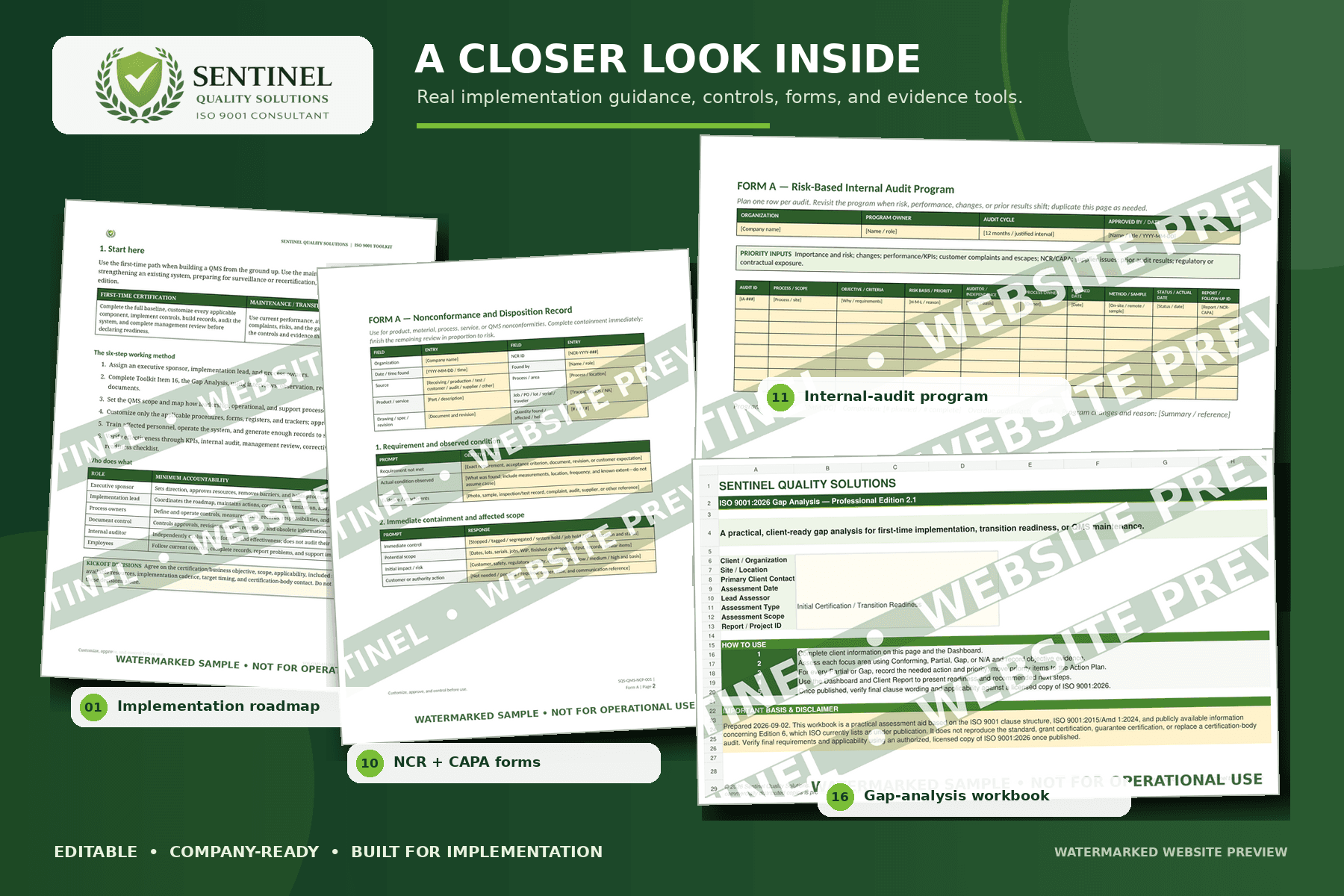
Watermarked Sentinel toolkit samples, including the internal audit program, corrective action forms, implementation roadmap, and gap analysis workbook.
Representative watermarked toolkit preview.

Component 11 of the complete toolkit

Connect auditing with the rest of your quality system.

The Internal Audit Program and Checklists sit within Sentinel’s ISO 9001 Certification & Maintenance Toolkit. The full system connects auditing with document control, NCR and CAPA, management review, and readiness work.

The Foundation Bundle covers a narrower starting scope. Choose the complete toolkit when you need the dedicated audit component alongside the broader QMS tools.

In development. Join the Toolkit Launch

Common questions

Using an internal audit checklist well.

Is a completed checklist enough for an ISO 9001 internal audit?

No. It is a working aid. Your audit needs defined scope and criteria, suitable evidence, evaluated results, and follow-up. A row of checked boxes without traceable evidence gives the next person little basis for understanding the conclusion.

How often should a small manufacturer audit its QMS?

Set planned intervals using process importance, changes, and previous audit results. ISO 9001 does not prescribe one universal audit frequency for every company or process. Review your program when performance or risks change, and honor any additional requirements that apply to your business.

Can our quality manager carry out internal audits?

Potentially, with suitable competence and arrangements that protect objectivity and impartiality. For work the quality manager owns, consider a competent colleague from another function or an independent external resource. Decide responsibilities when planning the audit.

Does this checklist cover every ISO 9001 requirement?

No. These are original manufacturing examples, not a complete clause checklist or a reproduction of the standard. Build your full audit program against your applicable licensed ISO 9001 edition, QMS scope, and other relevant requirements. Confirm edition and transition applicability separately.

Are the internal audit tools in the Foundation Bundle?

The dedicated Internal Audit Program and Checklists are component 11 of the complete Certification & Maintenance Toolkit. The Foundation Bundle has a narrower scope and does not contain that dedicated audit component. Check the toolkit page for current availability.

Can Sentinel help us prepare for an upcoming audit?

Yes. Discuss your current system, target date, and priorities with Sentinel. Gap assessment or certification readiness support may fit your needs, with scope and deliverables agreed in a proposal. Sentinel supports readiness and does not issue or guarantee certification.

Practical help for small manufacturers

Have an audit coming up?

Tell Sentinel what you manufacture, where your system stands, and when you need support.

Discuss audit readiness